I read Meng Xi Shi's Thousand Autumns (the 7S version) in just over a week, which should say how much I enjoyed it. It was faster and lighter reading compared to the other MXS book I've read (The 14th Year of Chenghua), but I knew to expect the history and politics infodump. To sum it up: loved ragebaiting asshole Yan Wushi, wanted to pet Shen Qiao, and perhaps offer some words of condolences to Yan Wushi's poor disciples.
My thoughts are here (thought on the whole story are in the book 5 post
So rushthatspeaks and I drove up to Montreal for Scintillation, Jo Walton’s little jewel of a convention. Our last trip north was a nightmare, through whiteout and on heart-stoppingly icy roads in a cranky electric car that needed charging minute for minute of driving. This time, the travel went as smooth as silk (save for an hour’s queue at the border going south). Green mountains, great clouds, conversation.
Scintillation is a great little con: intellectually intense, collegial, and gender-diverse. There is a panel room and a reading room, and for rest and recreation, a tea room and a jigsaw puzzle room. (I think we collectively finished three or was it four? Including this beauty.)
For my part, I did a talk on The Art of Greer Gilman. I read little passages from the books as facing-page texts.
These clayfolk are from my childhood, from Saturday morning art school classes.
And this is the poet Idony Caldwell from Lightwards, whom I drew last week.
I was also on three panels.
Is Translation Possible? As an argument against, I brought a blow-up of my Italian Moonwise cover.
(When I bewailed this to Caroline Stevermer back then, she misheard me. “A Bembo? How wonderful!” she said, envisioning a 15th century tarot card. “Which one?” I think the Bradamante in buskins is meant for Annis, but I can’t quite place the malevolent Munchkin with the golf club. Or the Jurassic Jabberwock.)
Writing Weird POVs, which was stellar. I recalled Wendy Walker’s The Secret Service (1992), set in a quasi-18th century Europe, where Great Britain’s secret agents metamorphose into objects: a crystal goblet on a cardinal’s table, a rose bush, or a statue of Thisbe.
How Do You Structure a Book? on which all five panelists could only describe our own processes in increasingly wild metaphors: kaleidscopes, clockwork, Fibonacci spirals, patchwork, fugues ... Fascinating.
I saw excellent panels on A Good Read, Neologisms, Trace Elements (the new book of critical essays by Jo Walton and Ada Palmer), What is it we love when we love SF?, The train to Aisnar (on Le Guin’s Orsinian Tales and Malafrena), Books That Are Impossible to Recommend, and What Can We Learn from Gene Wolfe? rushthatspeaks did a lovely interview with Sherwood Smith.
A group of us went to a fabulous M. C. Escher exhibit, with prints from his full career—tessellations, tangles, and impossibilities—with excellent wall text. I got a folder printed with the hands drawing hands.
There is spectacular eating on Montreal. Culinarily, I wasn’t as adventurous as many (not for lack of curiosity, but planning), but fortunately, the hotel is at the heart of Chinatown, half a block from streets of restaurants, bubble-tea shops, and bakeries. I had good dumplings, bao and egg tarts, and banh mi. And as a last hurrah, terrific dim sum on Monday.
...you make a post entirely to say hello to a whole bunch of people from an event you've never been to (but would love to go to someday, circumstances willing) and its associated Discord in which you mostly lurk, all of whom you're in the process of adding because so many lovely folks are talking about and, in some cases, newly joining DW.
Right? Or maybe just me? ^^; Things that happen when you spend time in many online places but mostly only lurk in all of them but this one? I just realized I didn't do any kind of recent-readings etc. post on the weekend. My brain is very tired, between the heap of manga deadlines and some garden-related stress. At this point I'll probably put it off until this weekend again, even though doing it sooner would be a good reason to post a bit more.
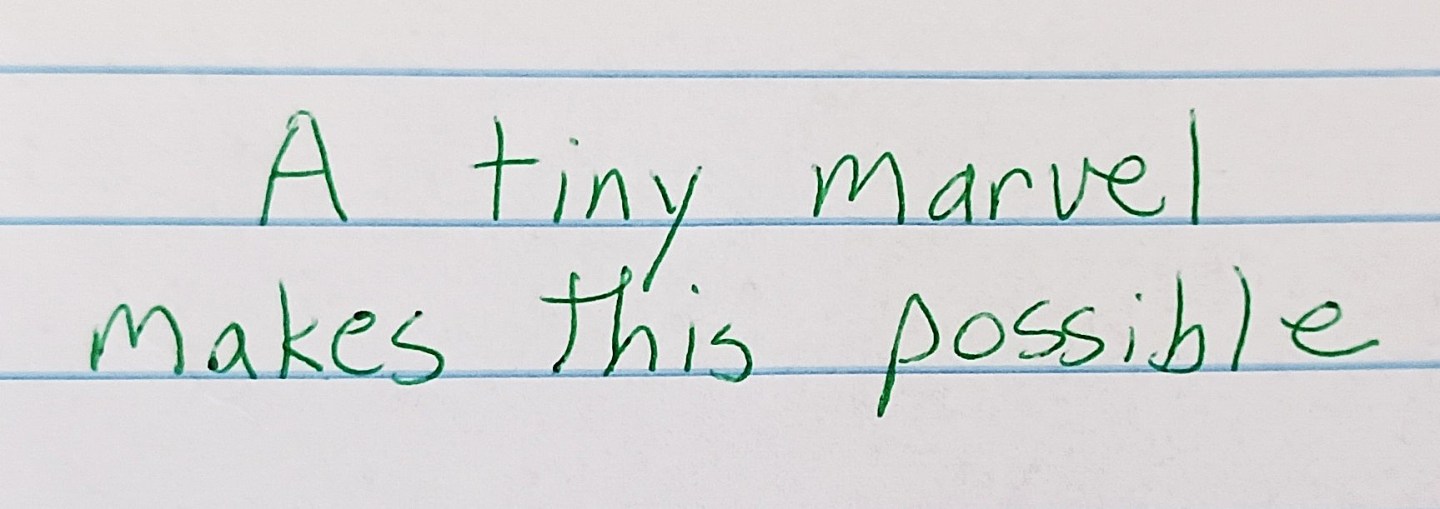
“Tiny” means one millimeter or less: a tungsten carbide ball sintered (fused) at 1400ºC for hardness, then polished, but not perfectly smooth. The ball at the tip of a ballpoint pen is textured. Tens of thousands of tiny pits called divots on the surface are connected by channels to assure the presence of ink and to grip the writing surface. The ball fits into a machined brass socket that holds it snugly and ensures the consistent flow of ink from the internal reservoir.
A ballpoint pen exemplifies the marvel of precision engineering. It’s something I use every day but could never make myself, even if I could get the raw materials.
The quill pen was used for writing by my European ancestors in medieval times. I suppose I could stroll into the park next door, tackle a Canada goose (unwise), nab some feathers, and make my own pen. But a common ballpoint pen costs about a dollar (when you can’t get them free as a give-away), less than the medical care needed after a goose attack. In that way, acquiring a ballpoint pen shifts the danger of production onto other people. Sintering sounds potentially hazardous.
But — did the ball point pen kill cursive handwriting?
Probably. Cursive was originally developed to accommodate the limits and flourishes of quill, steel-nib, and fountain pens.
In “How the Ballpoint Pen Changed Handwriting,” Josh Geisbricht wrote (probably on a keyboard), “Fountain pens want to connect letters. Ballpoint pens need to be convinced to write, need to be pushed into the paper rather than merely touch it.”
Likewise, Justin Ohms wrote in his Medium column that fountain pens love gliding. “Cursive is a perfect match for this, flowing, continuous, it just happens to be the handwriting style that treats a fountain pen like it’s on a moving sidewalk.”
Myself, I was required to learn cursive as a child, but as an adult, I worked for a long time as a newspaper reporter back when we had no better technology for taking notes than a rugged (ballpoint) pen and paper. I learned to write fast, a jumble of block letters and ligature that incorporated shorthand strokes. Cursive is beautiful, but it’s artificial, slow, tedious, and unnecessary, and I have no more patience for it than today’s young people.
It sorta came up in last week's read-in-progress post, but it might be fun to create bingo cards for authors!
So, here's an effort to crowd source ideas for your favourite authors (or authors you just happen to read more than one work from and found some patterns).
For each author proposed for the bingo card, leave a top level comment and then reply to that author with some patterns you've noticed. Feel free to link this out or just ask your friends! There are no right or wrong suggestions, as long as you are having fun and you've noticed it in at least two works.
swale (SWAYL) - n., a low-lying stretch of land, esp. a) (NE US) a low tract of moist or marshy land; b) (US) a shallow drainage with gently sloping sides, c) a long, narrow, usually shallow trough between ridges on a beach, running parallel to the coastline, d) a shallow depression on a golf course.
And a few other types of shallow troughs, that are relatively minor meanings. It's possible c & d are also regional senses but the dictionaries I found them in don't mark them as such. This dates back to the early 1400s as Middle English swale, originally a shady place, of unknown but presumably Germanic origin.
Silver Moon by Catherine Lundoff has been lingering on my TBR since it came out, but you really can’t go wrong with menopausal lesbian werewolves.
Becca lives in an isolated mountain town and, after her divorce, has made a life for herself with a house, a job at the hardware store, and active participation on a local womens’ club. Her story begins with a hot flash, soon followed by an invitation from her hot neighbor, Erin, to a menopause celebration party.
I was expecting more Romance plot; I am not sure why, but while there is romance happening, and Becca’s realization she’s attracted to a woman for the first time, this book is really a plotty fantasy novel. Because Becca is newish to the town and new to being a werewolf, the reader learns what’s going on, and the dangers that have been happening out of her purview, as Becca does.
The other werewolves in the town, and some of the humans, know more than Becca does, and like her I sometimes found that frustrating; she is part of the pack but ignorant of it’s recent history. That aspect of the book felt like a naive narrator tossed into a thriller, with new, unknown dangers at every turn.
It was a suspenseful light read for some hot summer days. Happy Pride!
I guess DW doesn't permit vids, as I tried to upload a wonderful 24 seconds of the train running alongside a bird drifting down the Hudson. Ah well, try to imagine it!
I had a delightful stay in Montreal (a bit crispy at first, then RAIN, then perfect weather) and another delightful Scintillation. So much book talk! Bought Cameron Reed's new book, What We Are Seeing and Jo Walton's just-about-to-come-out Everybody's Perfect, and for a launch panel discussed Emmet O'Brien's first two books in his Vega Victrix series, which he is publishing AT LAST. (I'd read some of it in draft over the years.)
Let me pause and give some thumbnail thoughs here; indie publishing depends on word of mouth (don't I know it!) and I think this space opera series really deserves it.
Both Your Houses is the first book. This series represents everything I want in space opera: intriguing skiffy balanced with complex characters whose emotions are not overwhelmed by the worldbuilding. Which is quite complex, but we learn about it gradually through Corin Oshima, our first-person narrator. She has a wry voice and a dry wit that makes everything, including info, interesting.
The author chose to keep the focus of this book on a specific case, while gradually widening the lens to afford a glimpse of the larger mystery.
Great alien design is another plus, and plenty of action. Corin is my favorite kind of hero--smart, cool, cognizant of conflicting moral algebra without being a jerk. I don't like jerk main characters; when everyone is a jerk, I lose interest in a story. Corin's story immersed me right from the start.
The second book, Ever Vexed With Storms, carries on from the first book. Don't begin with this one! This is a complex space opera universe and a complex story, though in the first two volumes, the author chose a mission/mystery structure, which provides enough guidepost for the reader to start assimilating the complicated background.
Corin continues to be awesome. I love it when the action catches up with her to see how she gets out of it. There's no "and then she leaped from the pit" cheats. Great aliens, high octane emotional entanglements, and a dry, delicious wit kept me immersed until the last page.
Right now they are only available at Amazon, which--whatever else you can say about them, and there's plen-ty to say--makes it relatively easy for the first timer to upload their work. More platforms will happen, and eventually print.
I got the rights back to my INDA series at last, and I've been like a pig in mud, cleaning up all the errors that I wish had been addressed long ago. It didn't get a professional copyedit, which I desprately need, but of course I'm responsible for the crap prose. Cringe, cringe, cringe. So it' time to address that the best I can, and this time there will be a list of characters, something about the ships, and the CORRECT map. That will happen early next month.
Aside from that, so many beautiful things seen and experienced! And today the homeward trip begins; I'd planned to walk to the train station, using up that four and a half hours between latest hotel checkout and needing to be due at Albany/Rensselaer, but the weather will be eighty. Not sure I want to drag a suitcase almost two miles in 80 temps, with sporadic thunderstorms in the forecast. Rain in June? In SoCal that would be a joke, but back here, it's entirely possible! Anyway so I will find a cafe, and hole up with a book and an iced chai latte instead, and decorously take a Lyft.
(I think this is the only icon I have with a baby.)
(This probably should be a fic, but I don't have the brain space to write fic right now.)
Preamble
Firstly, this isn't vague-blogging or subtweeting or whatever, and I'm not intending to tell any specific person they're wrong on the Internet. It's something that I've been thinking about since I saw FF:FS last year.
I'm further not telling anyone they should like the film if they didn't, or that they're bad for not wanting to watch a Disney movie prominently featuring pregnancy and parenthood. I'm sympathetic to having had enough of that genre and/or have been burned by it too many times. Totally fair! If you don't like plots with babies, you won't like this movie. There is definitely a baby!
I do, however, intend this to be something of a rebuttal to the "I don't like that the only female character was just a mom" line of criticism, which I've run into since the trailer. I also want to explain why I think that framing Sue's role as primarily a mother is reductive, and ignores some of the more interesting things the film was doing with her character.
Over the past week, I've twice had people express surprise that I've read the Odyssey. It wasn't about me reading in Ancient Greek (I didn't) or even that I read it when my age was in the single digits (I did), just that I'd read it at all. I don't know if it was general disbelief at someone having read The Odyssey or at me specifically having read the Odyssey, but now I'm curious: Do I give off "hasn't read The Odyssey vibes"? Have you read The Odyssey?
For what it's worth, I have read neither the prequel (The Illiad) nor the prequel's other spinoff (The Aeneid), though I did read its sequel (The Divine Comedy).
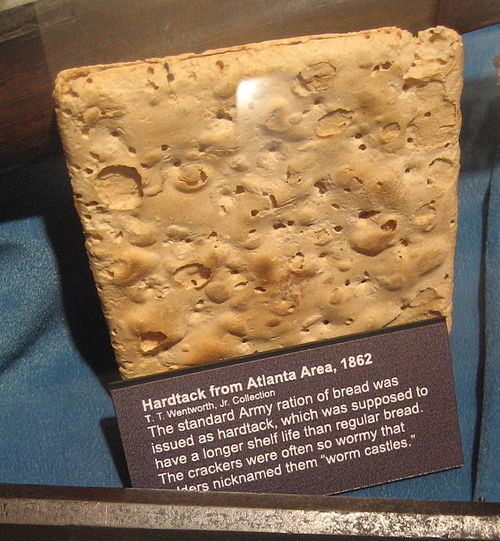
hardtack (HAHRD-tak) - n., a large, hard biscuit or cracker made from unleavened flour and water, formerly used as a long-term staple food, for example aboard ships.
Used not only aboard ships (often called ship's biscuit) but as military rations, and still used today in Alaska and Hawaii as a staple with a long shelf-life. Roman legionnaires ate bucellatum, which was basically the same thing only using different grained. What we'd recognize as wheat-flour hardtack is at least as old as the Crusades. This particular name interestingly doesn't show up until around 1830 (which is why you won't see it in Napoleonic sea-tales (unless the author's being sloppy)), naming tack, in the nautical/military slang sense of food generally, that is hard.
Stephen R. Bown, The Company: The Rise and Fall of the Hudson's Bay Empire. Of the three books I bought at the Montreal Museum of Archaeology and History, this one was the disappointment. It was fine, and it's not so bad when the worst you do is fine. However, it stopped when the HBC was no longer the de facto government of much of Canada, and I thought the transition from that to ordinary company was going to be the most interesting part. It also dropped facts in without context--things like "these two officials went from having Native common-law wives and families to being absolute bigots about other people doing that" without giving much of the larger scope, for example. Mine is a household where we might at some point have need of a book that covers the early history of the Hudson's Bay Company, so I'm shelving and keeping it, but unless you have that specific interest right now, I wouldn't recommend it.
Sarah Rees Brennan, All Hail Chaos. Definitely a middle book. Completely and totally a middle book, do not try starting here, the first one is still widely available and it is where you start to have any of the impact of what's going on here. You can have the outline of what's going on here, because the outline is all Generic Epic Fantasy, it's the emotional content that makes the isekai work as it does. Chaotically. Full of dread portent. Yeah. Still glad it's here, but start with the first one.
Shannon Chakraborty, The Tapestry of Fate. Second of the Amina al-Sirafi books, and I enjoyed it just as much as the first one. Time has passed, consequences have ensued, and this is a very different shape of plot while still doing much of what I enjoyed in the first one. I was a little frustrated by how long it took the characters to figure out their situation, but I was having so much fun I didn't mind too much. More of this please.
Molly Crabapple, Here Where We Live Is Our Country: The Story of the Jewish Bund. I think one of the things that Crabapple does particularly well in this history of a particular thread of Jewish thought is that she doesn't fall into the trap of "if you all had just listened to my relatives, we'd have been fine." She clearly has not only personal history but also personal sympathy with the Jewish Bund, but at no point does she mistake "these are/were my people, and I generally think they were right" with "and therefore they could have fixed everything." It's a period of Jewish history that's going to have very harrowing aspects but still worth knowing about, even/especially for Gentiles like me who frequently need to remind fellow Gentiles that Jewish thought is not all one thing; it's nice to have the footnotes on that.
Matthew Dimmock, Writing Tudor Exploration: Richard Eden and West Africa. Kindle. Small monograph that went, as he describes it, a very different direction than he'd intended. Interesting watching the Spanish influences and local pressures balancing each other out to get to what early Tudor exploration writing actually looked like.
Robert Foxcurran, Michel Bouchard, and Sebastien Malette, Songs Upon the Rivers: The Buried History of the French-Speaking Canadiens and Metis From the Great Lakes and the Mississippi Across to the Pacific. This is the last of the books I bought at the Montreal Museum of Archaeology and History, and it was very much better than the HBC history above, more nuance, more detail without getting bogged down, very clear points, good stuff and good to know, especially in the parts where this history has indeed been deliberately suppressed.
Ann Leckie, Radiant Star. The thing that really stuck out for me here is that Ann writes so calmly about such horrifying things. This time a famine! Other times other things! But the eerie calm of the prose tone made me practically climb the back of the couch. Super effective. I also like that she's taking the time for the stories around the edges of the supposedly big stories. The universe has room in it. Yes good.
E.C.R. Lorac, Checkmate to Murder and Murder in the Mill Race. Kindle. Quite cromulent Golden Age mysteries. I continue to like her and read what I can get of her, mostly from the library although I have a friend who also may be able to help.
Aimee Nezhukumatathil, Night Owl: Poems. A lot of these poems are fairly ordinary, but turned just so, in the way that poems can do, in the way that they don't have to be about something spectacular to be spectacular. Really enjoyed.
Sophie Pinkham, The Oak and the Larch: A Forest History of Russia and Its Empires. This is more a literary history than a natural history, although there are pieces of natural history in it. It starts in Siberia rather than with the Kievan Rus the way most Russian histories do, and the difference in point of view is interesting. Would like more like this.
Johannes Scheffer, The History of Lapland. Kindle. This is from 1670, and it is a wild ride. There's all kinds of stuff the Anglophone audience of the time does not find familiar, or Scheffer thinks they won't, so he explains things like nomadism and skiing. ("Leaping in wooden shoes." Well. You did your best, buddy.) Among the things that were fascinating here: the attempt to corral the Saami peoples to specific territories for grazing rights started in 1600, so this was fairly recent to Scheffer. The things he was outright wrong about were at least as interesting as the things he knew. He was also doing the very 17th century thing of "...uh...I saw this bit with my own eyes and it contradicts Olaus Magnus so...what do I do with that, let's take a minute." I wouldn't recommend this as your first book about this region and people, but once you're generally knowledgeable it's kind of a treasure.
Bogi Takács, Song of Spores. Alien aliens and super-sympathetic future humans and thoughts about spores, hurrah! I really enjoyed this.
Adrian Tchaikovsky, Pretenders to the Throne of God. Kindle. The latest in its series, and bringing several things full circle, so I wouldn't start here, I'd start at the beginning, even though it starts out looking like a stand-alone. One of my favorite things he's done.
Jane Yolen and Adam Stemple, Pay the Piper. Reread. This was the first thing I happened to grab when I got the news that Jane died and I wanted to do a bit of memorial rereading. Well, the first full-length thing: I did some dinosaur reading with the toddler across the street. I had fun with the Tam Lin aspects of it particularly, and with watching their two voices play together.
Marlene Zuk, Outsider Animals: How the Creatures at the Margins of Our Lives Have the Most to Teach Us. This book is primarily for people who have not thought a great deal about what, for example, coyotes or raccoons do in an ecosystem (in our ecosystem). If you have, it's not likely to be greatly revelatory, but maybe you'll want to get it as a gift for a loved one who is not hostile to the idea of complex ecosystems but hasn't really spent much time on the topic.
You may have noticed my absence from these pages. Aside from general busyness, I attribute this largely to the fractal complexity of family research, which has meant that every time I felt almost ready to share my latest findings, a new mystery opened up. So, I’m leaning into it a little bit. If all goes well, this will be the first of three posts on a person of whom I possess no image or manuscript papers, whose birth and death are alike mysterious, and who was in fact not a blood relation at all, but who played a central role in the family’s affairs over the three decades or so from the mid-1790s to the mid-1820s. This is Frances, also called Fanny, also called Fanch, who begins life as an O’Neill, then becomes a Butler, and finally a Sarmon.
There are three sets of mysteries I’d like to solve: one surrounds Fanny’s birth; the second the death of Charles Butler, her first husband; and the third the identity of “Daniel”, who may or may not be her son. I’ll do it over three posts.
So, Frances (or Fanny) Juliet O'Neill (or O’Neil) was baptized at St George, Hanover Square, on 17 March 1779. The figure on the right, which records the date of her birth, was clearly also initially written as a 17, but then altered to look like a 12. Whether that was just a slip of the pen, who knows? Either way, the parents are listed as “Clotworthy & Frances Oneile.”
The name Clotworthy O’Neill sounds pretty distinctive, and indeed it’s easy to find reference to a minor Irish aristocrat of that name from Shane Castle in County Antrim, who was born in 1688 and who died around 1749 in Bath, where he is apparently buried in the Abbey. So far, I’ve not been able to find any direct reference to his having children, but in 1763 another Clotworthy O’Neill – presumably his son or other close relative – pops up nearby in Bristol, where he marries a West Country heiress called Mary Arundell (1739-1793). A few years later, in 1767, they have a daughter, Phillis, who appears to be their only (legitimate) child. In due course Phillis marries a Clifton apothecary, William Mounier Yeo (1761-1809), “representative of the ancient and family of that name, seated at Huish, in the county of Devon.” Phillis and William live a prosperous life in Clifton and Hotwells, where the thriving spas of that era must have made the life of high-class apothecary very comfortable, and they have a numerous children, including one delightfully called Beaple. William Yeo dies in 1809 and Phillis lives on in Clifton until her own death in 1846, aged 79.
Now, why do I think that the Clotworthy O’Neil who appears on Fanny’s baptismal record in London’s Hanover Square is connected to the Clotworthy O’Neil who became the father of Phillis in Clifton, Bristol, 12 years earlier?
The main reason, apart from Clotworthy’s distinctive name, is that in later life Fanny is a visitor to “Mrs Yeo” in Clifton, from as early at 1798 to as late as 1821. There is clearly some connection: either they are half-sisters (if their father is the same Clotworthy) or perhaps more distant relatives (if there are multiple Clotworthys).
In any case, Fanny’s mother, recorded as “Frances Oneile”, is clearly not Mary Arundell. There are no doubt other possible interpretations, but the most obvious inference is that Fanny is Clotworthy’s illegitimate daughter.
Between her birth in 1779 and 1798 I have no information on her at all. However, in the latter year, she pops up in the Butler household in 6, Cheyne Walk, where she is apparently already a fixture. We first glimpse her in this letter from Weeden I’s third son, Charles, to his elder brother, George, who is in Prussia undertaking a Grand Tour of sorts. The scene is the Butler dinner table, and the dramatis personae are Weeden I, his wife Anne Giberne, his eldest son Weeden II, his daughter, Harriot, Charles himself, and … Fanny:
Now and then you have been thought of but generally in this Case, to reassure has been the chief Object till fond Anxiety had partly gained the Ascendancy, when paternal Affection always closed the Scene with some short Ejaculation for your Safety and Welfare. My Father generally began with “I think he might have written, since his last.” “There has certainly been Time enough,” rejoin’d my Mother. “Oh, there’s no knowing,” replied Weeden. “You can’t possibly tell if he’s hurried, or were likely so & so, & may be this & that,” with a thousand different Conjectures that he has the knack of being capable of forming. “Yes, but my dear,” retorts my honour’d Father, “it is now so many days since he has given us a single line,“ for he has the Dates as pat and regular as a four Hours Watch. “I should not mind, if he was only just to say, I’m well”; and then he chalks it out, as clear and as easy as he would a penny post Letter. I generally try in these Cases to slip in a Word edgeways, and desire him to recollect that in War Time, the opportunities are not as frequent, and to wait the Event of the next Mail. “Ah! Well! Well! I only hope he’s in perfect Health, but it’s strange I have not a Word; however, I’ll not think of him.” This concludes the discourse about your Worship whenever anyone happens to start a Clue for your Enquiry, and Tranquility is for a while restor’d. On these Occasions, Harriet and Fanny generally remain mute, thinking I suppose that the least said, as the whole can only be Conjecture, is the best.
It is also in this letter that we first hear of Fanny visiting Mrs Yeo:
Fanny is return’d from Mr Yeo’s of Clifton, which is tout près, and I never witnessed a more favorable Alteration than she brings from thence. She is grown quite stout, looks exceeding well, us’d to get up regularly at or before six …, and in general without experiencing Fatigue, from the Exercise.
At this point Fanny is just nineteen. There’s no indication that she and Charles are yet an item, but a few years later, in April 1803, another letter from Charles (this time to Weeden II) leaves no doubt. This one is written just a few weeks after Anne Giberne’s death, and Fanny has clearly played a key part in looking after the stricken Weeden I – a task more necessary because Harriet has (as related in an earlier entry) had something of a hysterical fit:
When I think of Fanny I am in Raptures, when I hear from her, I am overjoyed and almost unhappy at the ideas of leaving her. When I yesterday saw her, I was particularly astonish’d at her Deportment & Conduct throughout the different trying scenes she has almost latterly daily encountered
“No one so capable as Fanny!” is the Austenian mot juste, I think. Indeed, if there’s an Austen book that her story reminds me of, it’s definitely Persuasion. This will become clearer in the second part of her story, though in this first part there’s also a slice of Mansfield Park, with Charles in the role of Edmund.
Anyway, on 3rd October 1804 Charles and Fanny are married in St Luke’s Church, their local church in Chelsea. The marriage is performed by Weeden I, and Weeden II and Harriot are the witnesses, along with the church’s curate. There are no witnesses from the O’Neil side of the family.
At this point, my main questions are:
1) What is the secret of Fanny’s parentage? Does she share a father with Mrs Yeo? Who was her mother? 2) When, and how did she come to be living in the Butler household? And how did she spend her childhood before that?
The story of Charles and Fanny, but especially of Fanny, is not yet half done, but for now let us leave them in connubial bliss.
My poem "ἀγκυλοθάλασσος" is now online at Strange Horizons. I am indebted to radiantfracture for his Twine prompt generator designed to produce scientific-sounding compound adjectives and nouns, in this case the irresistible "ankylothalassic" from ἀγκύλος "crooked, bent" and θάλασσα "the sea." In the process of rendering it back into classical Greek, it acquired Twelfth Night and José Esteban Muñoz. It was written on New Year's Eve and I am very pleased to have it published in the middle of Pride.
Speaking of Strange Horizons, their Annual Fund Drive is underway! This year running on BackerKit instead of Kickstarter, thanks to AI. Please donate! The fund drive issue has already earned one poem, one short story, one essay, and two reviews, and more await. Not to mention the magazine continuing to pay its authors their well-deserved rates.
My week began with the wrestling of bureaucracy, but troisoiseaux has sent me a beautiful slim paperback of Duff Cooper's Operation Heartbreak (1950), about which I have been desperately curious since learning of it. The fact that Operation Mincemeat escaped containment into a novel directly precipitating the publication of Ewen Montagu's The Man Who Never Was (1953) is one of those points of history where the suspension of disbelief gives up.
At intervals accommodating my current ability to process film and TV, spatch has continued to show me selected episodes of visually potato, dramatically satisfying Star Trek: Deep Space Nine (1993–99), lately focusing on Jadzia Dax because we started with a couple of Sisko-centric episodes and then a couple of Quark and a couple of Bashir, and I am fascinated by the degree to which a show that couldn't commit to Garashir despite the best efforts of Andrew Robinson and Siddig el-Fadil just forgets to be anxious about queer and trans concepts around the Trill. Obviously I too am thrilled three decades on by "Blood Oath"'s iconically matter-of-fact "Jadzia, my beloved old friend!" but I was just as struck by Yedrin Dax in the grandfather paradox of "Children of Time" unselfconsciously recalling his wedding to Worf, slipping so naturally from the third person of a former life to the first person of memory that it leaves little room for rules-lawyering the gay away. The character himself was a predictable one-off favorite of mine from the first time around—his episode was one of a very small handful of DS9 I caught first-run, at which time it had no long-term chance in the intensity of my attention to Babylon 5 (1994–98)—but the constancy of affection asserted across the fluidity of bodies made so much sense to fifteen-year-old me that as with similar expressions by Tanith Lee, I took it as read and got to be surprised by its historical presence all over again in 2026.
Yesterday I got into the car to find WHRB playing the madrigal fable of Gian Carlo Menotti's The Unicorn, the Gorgon and the Manticore (1957), which I had known about but never heard. Later that night through more twenty-first century channels I heard Riah's "Other Side" (2025) and Thao's "Fossils" (2026).
So I was listening to "Move On" by Kevin Powers* because Shaboozey features on it. The song is from a guy to his ex, who has gotten over him a hell of a lot faster than he's gotten over her.** The chorus asks, Who taught you how to move on? Who showed you how to make it look so damn easy? ... I know you didn't learn on your own. Girl, who taught you how to move on?
Which is, all and all, misogynistic: she can't just have gotten over this loser, some dude has to have helped, and he's now mad at the dude because dudes have more agency. Et cetera.
However, it does sound a little like he's asking for a hook up, since his rebound flings have not been satisfactory, and he would like to try out the dude who's been working so well for her. As the bridge says:
Who's been keeping you up at night? Seems like you've been doing alright. Maybe I'd be too if I knew: Who taught you how to move on?
🤔🤔🤔
* I just watched the video so I could link to it, and it's very funny to me that they don't show Shaboozey actually in the motorhome because he is tol. ** I guess he could be saying "Girl" in a gay way, but I suspect not coming from Kevin Powers. Note, also, that she seems to have moved to California and cut her hair, so...
Also called ring dove and, in northern England and Scotland, cushat. In Old English it was cusceote, which is bizarre as it looks like a compound of cow + shoot, and no one has a good explanation of what exactly that's supposed to mean. Queest/quist/quyshte/other spellings were variations on that stem that appeared in Middle English, in the 1400s, and are uncommon today outside of historical fiction (or at least less common than cushat).
Two lifers since my last update, both at the pond: Black-billed Cuckoo with its soft but curiously percussive cucucucu, cucucucu, and Bank Swallow, a brown swallow with a neat collar, swooping around with the more colorful mixed flock of Tree Swallows and Barn Swallows. The pond also had a visiting Blue-gray Gnatcatcher which caused a stir as they're not common here. It wasn't a lifer for me, but my first in Vermont.
The summer flycatchers have arrived: Alder Flycatcher, Yellow-bellied Flycatcher, Eastern Wood-pewee, the dapper Eastern Kingbird in its tuxedo, and Willow Flycatcher whose fitz-pew call sounds appropriately like a hayfever sneeze. Veery is also back, which (apologies to the others) is my favorite thrush, with its descending Nintendo-like call. (I would have called it the 8-bit Thrush if anyone had asked me.)
But at home things have been even more exciting—we have baby birds!
I first spotted the fledgling Northern Cardinal above on the 5th, and it's been foraging below our feeders every day since. It's able to fly and find food on its own perfectly well, but whenever one of the parents is nearby it begs and flutters until they feed it. ❤️ Dad is the more indulgent parent and feeds it the most, while mom has a low tolerance for its feigned helplessness.
Book 23, as I discuss in the first post to this book, revisits political and heroic themes from books 1 and 2 and offers an opportunity for the epic’s participants and audience alike to reconsider issues of honor, distribution, and institutional order through Achilles’ chairmanship of the funeral games for Patroklos. Often these games are seen as “filler” or a digression following the violence and deaths of books 20-23; but as many others have noted, the whole book is a matter of ritual performance with deep ties both to the material experiences of ancient audiences and to myth in general.
One of the harder things for modern audiences to sense is the extent to which Patroklos’ death in the Iliad is anticipation of or in surrogacy for Achilles’ outside of the Iliad (usually located in the lost cyclic poem the Aethiopis). As I have written about before, I get a little nervous about some of the approaches that fall under the scholarly rubric of “neoanalysis”—the general approach that explores how the Iliad relates to ‘prior’ or, in better cases, ‘other’ narrative traditions. It makes me anxious because, while in its best form it can provide us with an idea of how the Iliad absorbs and responds to other motifs and stories, it too often provides the impression of hierarchical relationships between tales and that certain episodes were fixed in specific ‘poems’ to which ancient audiences had access.
There’s a lot of uncertainty in such assumptions about the relationship among various narratives and what audiences knew. When it comes to the funeral games in particular, this approach surfaces because they are often seen as an echo/doubling/recapitulation of/model for the funeral games for Achilles. As a general rule, I am not opposed to the idea that there is a significant relationship between the episodes, I just think it more likely that an epic grammar of funeral games developed around retelling of tales that centered the death of a great hero and, further, that the depictions of the burial honors for Patroklos and Achilles were so interdependent in their development over time that any ancient audience member would be hard-pressed to articulate clearly where one began and another ended.
This presupposes the timelessness of performance, the space that is created outside a hierarchy of what story was told when by the ever pressing now of the story being told. I think part of the power of the Iliad’s funeral games resides in how much we understand them as anticipating Achilles’ own death and burial. But given how much Achilles is central in the games and how thorough the political theme is, it is really hard to imagine how to evaluate this power. We would need to know what audiences knew, and that is at some level impossible.
Before we get to the games, however, we have the issue of the burial itself. One of the surprising things about book 23 is its setup: most people remember the elaborate games; I think far fewer remember clearly the continued mutilation of Hektor’s body at the book’s beginning, the slaughter of the 12 Trojan youths, or Patroklos appearing as a ghost to chide Achilles for not burying him already.
Homer, Iliad 23.59-92
Peleus’ son was lying there on the strip of the much-resounding sea, Groaning deeply among the many Myrmidons, In a cleared space where the waves were lapping at the sand. There sleep found him, softening the concerns in his heart, Once it fell around him, sweet. His powerful limbs were exhausted From chasing Hektor toward windy Troy. Then the soul of pitiful Patroklos arrived Alike to himself in every way, in size and his beautiful eyes- His voice too, and he had similar clothes enveloping him. He stood above Achilles’ head and addressed him. “You are sleeping? Then you have forgotten me, Achilles. You were never careless when I was alive, but now I am dead. Bury me as quickly as possible so I can enter Hades’ gates. The souls, those little ghosts of worn out men, are holding me far off— They will not allow me to join them beyond the river at all, But I am wandering like this through the home of wide-gated Hades. Give me your hand too. I am in sorrow, since I will never again Return from Hades, once you have granted me fire. We will never again sit alive, apart from our dear companions, Making our own plans together. Now a hateful fate has Swallowed me whole, the allotment given as I was born. This is your fate too, Achilles, even though you are like the gods, To die in front of the walls of the wealthy Trojans. But I am going to tell you something, I’ll ask you, if you’ll listen. Don’t keep my bones apart from yours, Achilles, But just as we were raised together in your home, When I was just a young child and Menoitios send me From Opoeis to your home because of a painful murder, On that day when I killed the son of Aphidamas, the fool I was, I did it unwillingly, sent into a rage over a game of dice. Then the horseman Peleus welcomed me into your home And raised me in a kind way and named me your attendant. So have one vessel safeguard our bones together, A golden chamber with two handles, the one your mother gave you.”
Achilles and the Shade of Patroclus, 1793. John Flaxman. MET
The sequence of events that leads up to this speech is remarkable enough that a scholiast felt the need to comment on the sudden change. At one moment, we are witnessing Achilles mourning on the sea, and then he is asleep and a dream is looming over him.
Schol. bT ad Hom. Il. 23.65a
“The sudden change is credible: for, after Achilles’ lamentations, the poet has devised something rather new, and he has provided words for someone who died through a dream.”
The language the scholiast uses here—peripateia—is reminiscent of the terminology Aristotle uses for tragedy. In Greek drama, from an Aristotelian perspective, the peripateia is a reversal, a sudden inversion of fate or outcomes that (sometimes) drives audience and/or character towards a recognition (anagnorisis). The sudden turnabout here is nearly akin to a divine intervention. Patroklos appears, but as George Gazis notes, he is not an envoy of the dead in the same way that is represented in book 11 of the Odyssey. Instead, he appears as a dream. The immediacy of it and the rapid transition leaves us little time to think about the other dream in the Iliad, the false dream sent by Zeus in book 2 to persuade Agamemnon to lead his people to war that day (in part to honor Achilles’ request and advance the ‘plan’ of the Iliad).
I bring up that first dream for thematic and structural reasons. Thematically, dreams elsewhere are sent by the gods. Here, we have no agent, no spoken reason. Unbidden, a supernatural force appears to Achilles and confirms his course of action, providing additional information to the audience. It is tempting to read this, as some do, as an exploration of Achilles’ guilt rather than a literal ghost in a dream; but the vividness and detail leads me to believe that ancient audiences would have taken this as a literal dream. Again, thematically, this makes sense for where we are in the epic.
Dreams and sleep are often paired in early Greek myth as moving between the realms of the seen (the world of the living/day) and the unseen (the underworld/night). Achilles, moreover, has been depicted directly and indirectly as separated from the realm of the living, so much so that when Priam travels to meet him in Iliad 24, he is guided by Hermes, whose role as the psychopompos (the “marshal of souls”) is to guide the dead to Hades’ realm. Perhaps we can imagine Achilles in a space where the fabric between the realms is thinning, frayed, and Patroklos can reach him thanks to their indelible bond, stretching across life’s final boundary.
(Although, to be fair, this sounds a bit too much like a tagline for the movie Ghost.)
Whether we see Patroklos as an actual ghost or an outlet for Achilles’ conscience, the speech provides some background for their relationship and an implicit critique of Achilles. The story Patroklos tells about how they came to know one another is explained in another scholion.
Schol. D ad Il. 12.1 [see Apollodorus 3.13.8]
“Menoitios’ son Patroklos grew up in Opos in Locris but was exiled for an involuntary mistake. For he killed a child his age, the son of the memorable Amphidamas Kleisonumos, or, as some say, Aianes, because he was angry over dice. He went to Phthia in exile for this crime and got to know Achilles there because of his kinship with Peleus. They cemented a deep friendship with one another before they went on the expedition against Troy. This story is from Hellanicus.”
The detail I think is really interesting here and in the speech is that Achilles and Patroklos were brought together by a rage-induced mistake that shattered one community only to create a new one. Patroklos starts out by telling Achilles that he is still suffering, that he cannot rest because Achilles has not cared for his body. Achilles’ rage, then, has been entirely for himself. It had no hope of raising the dead and only has increased the amount of bodies to be buried.
Patroklos reminds Achilles of his own story only after he asks him to make sure that their bones are interred together in one vessel. When he reminds Achilles of how they came to be together, he uses a thematic word for anger (kholôtheis) that should remind audiences of all the damage anger has done in the Iliad’s world. I suspect that Patroklos’ story redounds on Achilles as well, inviting him (and us) to think about the other actions undertaking “unwillingly” and their outcomes, the way Achilles’ anger led him to pray for his people to suffer, the way his people suffering meant Patroklos’ death too.
The point, I think, is an analogical one: the union in death following rage and its ruin is a remaking of life, but in a final fashion. Just as Patroklos’ childhood error led to an adolescent life with Achilles, so too will Achilles’ adult mistake still lead to a kind of eternal life with Patroklos. It is a small solace and no replacement for a life together, but it is something. And it is something Achilles, now, has to create on his own. If there is a peripateia in this moment, it is to be found both in the plot (a move from lament to action) and in the character who drives the plot.
The blending of the Achilles and Patroklos in death—both through the metaphorical overlapping of tales and the literal blending of bones—should remind us of the powerful themes of surrogacy that bind Achilles and Patroklos further together. In this near-final articulation, however, I wonder how much we need to consider Achilles response and the subtle narrative revelation that Achilles reached out to him, but could not grab him, because his spirit “like smoke”. Achilles’ request for an embrace is unfulfilled, yet he turns almost immediately to start the process of burial.
One of the things I emphasize when talking about Achilles’ amazing second lament for Patroklos is that he still seems to be expressing his own sense of loss primarily. This is, of course, a realistic representation of grieving and I may be mistaken in believing that it is only a step toward a broader sense of loss in the world. When my father died suddenly at 61, I don’t know that I started to grieve for what he lost until years later and it was prompted mostly by feelings of joy, tempered by his absence. In times of loss I have come to think more about what the missing miss out on: for my father and his mother, getting to see my children born and grow, taking joy at their joy in the world, and comfort with a world born anew through them.
In my reading of the multiple audiences to Achilles’ speech about his disappointed expectation that Patroklos would be the one to live on and take his place in the world, I think the Iliad is anticipating the epic’s end, when Achilles ever so briefly sees Priam as real through their intersecting yet separate pain. Part of the point of dramatic narrative, I think, is to give us an access to a world outside ourselves, to help us fill our bodies and minds with others’ light and love, both so we can be more unto ourselves and we can make a better world alongside others because we know they are real.
But even this approach, as magnanimous as it might sounds, runs the risk of instrumentalizing others’ pain for the sake of individual gain. Just as easily as someone can mourn what a loved one misses out on, we could take the opposite corollary, to celebrate all they will not suffer. Such a pessimistic view is not far off from the so-called “wisdom of Silenus,” that the best fortune is not to live long or die in glory, but never to have been at all.
And yet, for all it’s apparent logic, this seems too bleak. An epic so invested in showing us the power of loss, can’t possibly be telling us that a superior alternative is never feeling love at all.
Johann Heinrich Füssli (1741-1825). Achille saisit l’ombre de Patrocle, vers 1810 Mine de plomb, craie et aquarelle – 34 x 60 cm Zurich, Kunsthaus
A short Bibliography on the Ghost of Patroklos
n.b this is not an exhaustive bibliography. If you’d like anything else included, please let me know.
Anderson, Warren D. “Achilles and the Dark Night of the Soul.” The Classical Journal 51, no. 6 (1956): 265–68. http://www.jstor.org/stable/3292885.
Arft, J., and J. M. Foley. 2015. “The Epic Cycle and Oral Tradition.” In Fantuzzi and Tsagalis, 78–95.
Emily P. Austin, Grief and the hero: the futility of longing in the Iliad. Ann Arbor: University of Michigan Press, 2021.
Jonathan Burgess. The Tradition of the Trojan War in Homer and the Epic Cycle. Baltimore: Johns Hopkins University Press, 2003.
Fantuzzi, M. 2012. Achilles in Love. Oxford.
Devereux, George. “Achilles’ «suicide » in the Iliad.” Helios, vol. VI, no. 2, 1978-1979, pp. 3-15.
G
azis, George Alexander, ‘The Dream of Achilles’, Homer and the Poetics of Hades (Oxford, 2018; online edn, Oxford Academic, 24 May 2018), https://doi.org/10.1093/oso/9780198787266.003.0003, accessed 19 Mar. 2024.
Lesser, Rachel. 2022. Desire in the Iliad: The Force That Moves the Epic and Its Audience.Oxford.
Lowenstam, Steven. “Patroclus’ death in the Iliad and the inheritance of an Indo-European myth.” Archaeological News, vol. VI, 1977, pp. 72-76.
Mouratidis, Ioannis. “Anachronism in the Homeric games and sports.” Nikephoros, vol. III, 1990, pp. 11-22.
MUELLNER, L. Metonymy, Metaphor, Patroklos, Achilles. Classica: Revista Brasileira de Estudos Clássicos, [s. l.], v. 32, n. 2, p. 139–155, 2019. DOI 10.24277/classica.v32i2.884
Mylonas, George E. “Homeric and Mycenaean Burial Customs.” American Journal of Archaeology 52, no. 1 (1948): 56–81. https://doi.org/10.2307/500553.
Paschalis, Sergios. “The Epic Hero as Sacrificial Victim: Patroclus and Palinurus.” Hermathena, no. 199 (2015): 135–58. https://www.jstor.org/stable/26921696.
Rengakos, Antonios. “Aethiopis.” The Greek Epic Cycle and its ancient reception : a companion. Eds. Fantuzzi, Marco and Tsagalis, Christos. Cambridge: Cambridge University Pr., 2015. 306-317.
Roller, Lynn E. “Funeral Games in Greek Art.” American Journal of Archaeology 85, no. 2 (1981): 107–19. https://doi.org/10.2307/505030.
Russo, Joseph. “The Ghost of Patroclus and the Language of Achilles”. Euphrosyne: Studies in Ancient Philosophy, History, and Literature, edited by Peter Burian, Jenny Strauss Clay and Gregson Davis, Berlin, Boston: De Gruyter, 2020, pp. 209-222. https://doi.org/10.1515/9783110605938-012
I went to Napa this weekend to judge and had a good time. Chena had a much better time. Donald and I were camping with my friend Christy. Christy has a new puppy, a 4 month old Anatolian Shepherd / Lab / Mastiff named Hope. At my April event she was half Chena's size. Now she is a lanky, awkward ball of white fluff and is only a few pounds lighter than Chena. Hope and Chena had a wonderful time playing together. This morning Hope started chewing on a tattered remnant of a chew stick. She abandoned it, Chena picked it up. Hope wanted it back. Christy, who was monitoring the situation, got Hope a new chew. Hope took it politely but thought it was much more fun to try to get the old stick back... Chena groweled halfheartedly at her a couple of times and then ignored the puppy who sat down on Chena's butt. A few minutes later this was the view:( Pics )
I've been meaning to read one of Bora Chung's short story collections, but instead I read her novel Red Sword (translated by Anton Hur) because this is the one that came into my house via my wife's library pulls. I found it striking, unsettling, minimalist and strongly visual in a way that immediately conjured up the sense for me of a particular kind of animated film -- in my mind, it's that kind of unsettling rotoscope animation, mostly black-and-white with flashes of bright signifying color.
The protagonist of Red Sword is a prisoner on a spaceship who has been brought to an alien planet with numerous other prisoners to do battle in a war that she doesn't understand. The planet is strange and white; the aliens are strange and white; big black birds fly overhead, and they're strange too. The prisoners haven't been given guns, but the people holding the prisoners don't seem fully aware that the protagonist's sword is a weapon as well. So: she has her sword. She has a lover, who dies in the first few pages. She has comrades; a pair of lesbians that she knows only as Indigo Skirt and Light Green Skirt, and an older man who seems drawn to her for reasons neither of them quite understand, but as things they don't understand go that one's pretty far down the list and gets further all the time as weirder things continue to occur. And she has memories of her childhood, a home she used to have, and hopes to have again.
The first portion of the book is mostly just a desperate struggle for survival, caught between the incomprehensible aliens on one hand and the equally incomprehensible force of their captors on the other, and then on the third hand the incomprehensible landscape of an incomprehensible planet. Then things get weirder. The book has things to say about constructed identity, the nature of the self, and the nature of big horrible systems; the arbitrary and unilateral nature of oppression under imperialism. The prose is very clear, very sparse, with a kind of deliberate simplicity that lays bare the confusion and horror of the whole situation: if you don't know or don't like what's happening, it's not on account of the way it's been told.
I don't know that I enjoyed the book, per se, but I think it will linger with me. The part that stuck with me most is when ( spoilers here )
Our local church has an annual midsummer festival - an Eco-Fest - but because it is at midsummer, we are quite often away when it happens. Not this year, so we went up this morning to have a look round. It seemed busy: lots of stalls doing lots of business with lots of people, all of which is good. We met and chatted to several friends and neighbours, and rather to my surprise I bought things: a loaf of bread, a stick deodorant, a picture of a puffin, a birthday card and two small ceramic decorations which will probably be Christmas presents. I did not buy a ceramic half pomegranate:
because what would I do with a ceramic half pomegranate? Now I think, well, I would hold it (it was very tactile). This is silly; I don't even like pomegranates very much...
Since our lunch in York, at which J mentioned that she has an Instagram account, I have been poking around Instagram, where I have a defunct account that I set up during lockdown because there was a video I wanted to watch. This afternoon I tried an alternative tack and set up a new account on my phone, hoping it might be a good place to save silly phone pictures. This was very hard work, and I haven't yet figured out to to make it show me content I am interested in. Work in progress...
A friend gave me her old aircon, I lugged it up three flights and got it set up, and ...it turns on and does nothing. I'll take the filter out and clean it tomorrow (UGH) but if that doesn't work, I am out of ideas. (Yes, I looked for the manual online. The troubleshooting tips are not helpful.)
Semi-relatedly, I still need to sort out repairing the oven and the dishwasher, which are both, separately, fucked up. Physical reality is the worst.
I can't remember if it ever occurred to me before last night's re-read of Jane Yolen's Neptune Rising: Songs and Tales of the Undersea Folk (1982) that her Greyling (1968) resembles Gordon Bok's "Peter Kagan and the Wind" (1971) in that both are stories of selkies who return to their seal-selves not despite the bonds of human love but because of them—a father in one case, a husband in the other, both fishermen in peril on the sea. Bok and Yolen knew one another; she partly dedicated the collection to him. It's slightly nuts to me that he never set either of her sea-songs published in it, since it takes so little imagination to hear "The Ballad of the White Seal Maid" or "The Selchie's Midnight Song" in his deep-grained swell of a voice. I don't know whose version coalesced first. I grew up on both of them.
This week I'm reading: I am currently in the middle of Naomi Mitchison's To the Chapel Perilous (1955), the paperback reprint sent me by boxofdelights in 2022 as a replacement for my long-lost, lent-out college copy. Also re-reading Yolen's Merlin's Booke (1986), the Ace first edition inherited from my god-aunt in 2000 which I had not then read since my childhood in the Cambridge Public Library. For the first time, Jonas Kreppel's Adventures of Max Spitzkopf: The Yiddish Sherlock Holmes (trans. Mikhl Yashinsky, 1908/2025), a present from my parents earlier this year. With snail-mortifying slowness, I am continuing to poke at the modern Greek of Nikos Kavvadias' Πούσι (1947).
My favourite book of all time is: Impossible to answer. I did that hundred books meme last spring and kept having to append titles that had slipped my mind.
My current favourite book (read or re-read in the last 3 months): With apologies to Molly Crabapple and Seamus Heaney, almost certainly Leon Garfield's The Stolen Watch (1988).
The last book I bought was: Joan Coggin's Dancing with Death (1947), a present for my mother which she promptly loaned back to me so that she could discuss it. The last book I bought for myself was Andrew Hiller's Hornytown Chutzpah (2026), brought to my attention by mrissa.
The first book I bought with my own money: No clue. My first real job was in a science fiction and fantasy bookstore when I was fifteen and they might as well have paid me off the shelves.
The first book I received as a gift: Equally impossible to estimate. I can remember receiving Brophy's The Prince and the Wild Geese (1983) early on, but it would not have been the first.
The last book I received as a gift was: Molly Crabapple's Here Where We Live Is Our Country: The Story of the Jewish Bund (2026), courtesy of a_reasonable_man.
The last book I borrowed from the library: Either Kevin Lynch's The Image of the City (1960) or What Time Is This Place? (1972), whichever was not checked out first.
The book physically closest to me right now: Robinson Jeffers' Such Counsels You Gave to Me (1937), the burgundy-boarded, jacketless first edition from my grandparents' house. After that, Imogen Sara Smith's Buster Keaton: The Persistence of Comedy (2008), which I gave some years ago to spatch.
Do you read bookfic, and if so what is your favourite bookshop fic? I don't think I have ever read a bookshop fic. I read Satoshi Yagisawa's Days at the Morisaki Bookshop (trans. Eric Ozawa, 2010/2023) when spatch gave it to me for our last anniversary.
This or That
Physical book or e-book: Physical book if at all possible, since I process them differently. E-book in the inevitable event that I can't get hold of something and there's one copy digitized maddeningly on the Internet Archive.
Used or new: As a reading experience, I don't think it makes much difference to me. If I own a book, I try to keep it in good shape.
Fiction or non-fiction: At the moment I seem to be reading more fiction than nonfiction, which may or may not be the case in another three months.
Read at a coffee shop or at the park: I haven't been inside a coffee shop in years. Last Friday I was reading on the stone wall overlooking the water at Spy Pond Park while waiting for ladymondegreen.
Paperback or hardcover: In terms of preferred reading format? I don't think it makes much difference to me, either.
Romance or Crime: More crime than romance.
Yes or No
Stream of consciousness? Yes.
Poetry? Yes.
Memoirs? Yes.
Philosophy? Yes.
Thrillers? Yes.
Chronicles? What?
Dialogue heavy? Alan Garner?
Current Music:Gordon Bok, "Peter Kagan and the Wind"
![[personal profile]](https://www.dreamwidth.org/img/silk/identity/user.png) shipperslist posting in
shipperslist posting in ![[community profile]](https://www.dreamwidth.org/img/silk/identity/community.png) cnovels
cnovels


![[syndicated profile]](https://www.dreamwidth.org/img/silk/identity/feed.png)